
Premier League money has lost all meaning amid chaotic spectacle of excess | Barney Ronay

There was a research study a few years back into a key period in the life of the TV show Location, Location, Location. You know the one. Half an hour of mid-morning drift. Hosted by two people whose common quality is they both look as if the minced essence of Wellington boots, the Volvo XC40 and the phrase “picky bits” has been reconstituted into human shapes, then sent out to judge people for buying houses.
The big reveal was always the bit where they came back a year later and saw how much the value had shifted. Because all conversations about houses are, in the end, an excuse to talk about money. Oh wow, it’s gone up by £20,000. You are good. Oh no, you’re now bankrupt and your flat looks like a hostage cell with fairy lights. Unlucky. You are bad.
Premier League transfer talking points: three things we learned from the dataRead more
What the study found was that prices basically always increased. Ripping out the stairs, living in a tent in the garden, arguing about what to do with the two-and-a-halfth bedroom – all of this was irrelevant. These were the boom times of the early 2000s, UK housing recast as a global money trap, an endlessly whirling laundromat, a bricks and mortar central bank bond.
These people could have bought their run-down three-bed, left it empty and done absolutely nothing for two years. The price would have still gone up. That drama about exactly which shade of Anaconda Breath Morgue And Cakebread Mega-Gloss to use in the underfloor wine cave? Just doesn’t matter. Buy the soil. Shut the door. Let money do its thing.
And yes, this is a way of talking about the 2026 summer transfer window, and the way in which everyone has basically now been Chelsea-ed. Think back four years to the start of the age of Clearlake, the first post-Roman spree. At that time it seemed impossible there could be a profitable outcome. Chelsea were out there buying the vintage copper-plate statement bidet. Chelsea were digging out a third sub-basement. Who will redeem this expense? Who will provide a similarly deranged response to such overinvestment?
Well, it turns out the market will do this for you. If you’d predicted then that Chelsea would miss out on the Champions League and go through five permanent managers, but still make a profit from selling Enzo Fernández, would anyone have believed it?
 View image in fullscreen
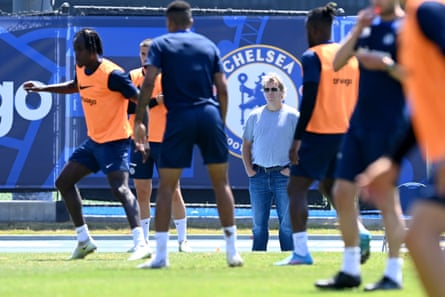
Todd Boehly has overseen big changes on and off the pitch during his time at Chelsea. Photograph: Darren Walsh/Chelsea FC/Getty Images
Or that Mykhailo Mudryk could run around briefly like a deranged hamster, get banned for failing a drugs test and still become a potential growth asset? This is pre-subprime crash energy. Yes, you can install a solar-powered mega-wetroom that fires sourdough breadsticks directly into your eyes. Whatever. Ownership is all. Money will take care of you.
There are still levels to this. The one Chelsea thing to shift in the window is that the curtain has now been drawn on those initial eight months, the period where Todd Boehly became the world’s worst director of football, a director of football who basically didn’t know what football was.
That period has now been safely capped off. Only two players remain. Rough out the numbers and Chelsea spent something like £200m in fees, wages, leaks and cuts, with only Malo Gusto and Wesley Fofana to show for it. No real damage. Money comes, money goes. We roll on.
This is the lesson of the latest summer transfer window. Right now it doesn’t really matter what you do in the Premier League. Just being in it is the thing. With one caveat, which is that nobody actually knows what’s happening here. We can marvel at a record window. We can see the biggest spenders are Manchester City on £457.5m, the lowest Crystal Palace on about £50m, the highest net Liverpool on £216.8m. We can pore over Aston Villa buying the bones of a new squad for £56.7m net gain.
 View image in fullscreen
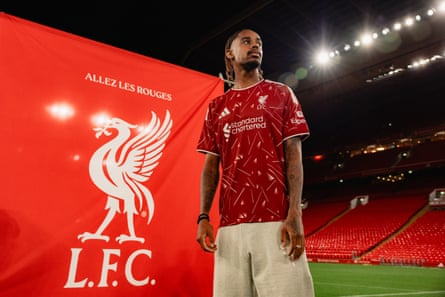
Liverpool’s £123m signing Bradley Barcola checks out Anfield. Photograph: Liverpool FC/Getty Images
But we can’t know what it means, at least not financially. This is part of the design of money on this scale. As the then Federal Reserve chair Alan Greenspan put it in a famous speech on the mysteries of big money: “How do we know when irrational exuberance has unduly escalated asset values, which then become subject to unexpected and prolonged contractions?”
Nobody knew what this meant then. Nobody knows what it means now. “Irrational exuberance” is a good phrase, one Greenspan later said came to him in the bath. It was designed to convey the essential point: opacity, vagueness, invisible flows. If not for those actually riding the tide, because someone is always making money. Someone out there actively wants the Premier League’s financial chaos, and is benefiting from it gloriously.
Otherwise, reading the runes is just a matter of guesswork. Money moves between networked entities. Everyone inside wins. Everyone outside pays for it. But still, this feels new, if only in its extremity.
This was captured by the weirdness of Sky Sports’ transfer deadline programme on Tuesday. At one point a man appeared strumming a guitar, smiling as if he had just filleted a litter of kittens in his basement, and sang a Bradley Barcola Liverpool song to the tune of Don’t Dream It’s Over, like this is all just normal and fine.
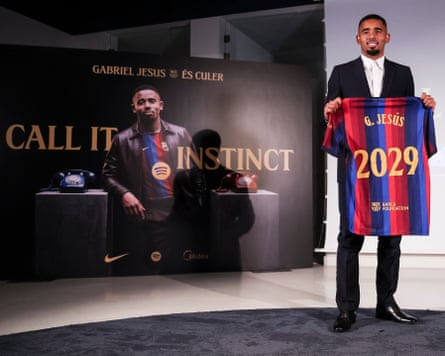
Later there was a golden period at about 5.30pm where every deal just seemed wrong and impossible, a fever dream after an over-ripe seafood risotto. Aston Villa have paid £47m for an 18-year-old winger. Gabriel Jesus is going to Barcelona. Jack Grealish is having a medical at Everton, an event that seems to prove the non-linear nature of time, a medical that is always happening, never not happening, a constant time-space event.
 View image in fullscreen
Gabriel Jesus at his Barcelona unveiling. Photograph: Javier Borrego/AFP7/Shutterstock
Meanwhile two private jets are on the tarmac in Lyon as three clubs try to sign Malick Fofana. “We STILL don’t know what Malick Fofana is thinking,” the man with the microphone concluded, mournfully, and this seemed profoundly true and on point. We don’t. Does Malick Fofana even know this? If so, how can he? Nobody else has a clue what’s going on.
skip past newsletter promotion
Free newsletter | Every weekday
Sign up to Football Daily
Kick off your evenings with the Guardian's take on the world of football

Enter your email
Sign up
after newsletter promotion
It is worth trying to list the best deals. Harry Wilson on a free can only be good. Djed Spence to Inter is great. Forza , Djed. Barcola to Liverpool for £123m is lots of money, but he’s really young and knows how to score once he’s settled.
Newcastle seem to have had a good window, racking up a list of signings that scream inside knowledge and good data, and chime with Matthias Jaissle’s mercurial vibe. Manchester City’s signings have to be good. There’s so many of them, and they’re all excellent players. That midfield is surely just too big to fail.
Arsenal will also be fine, despite not signing a 1950s-style hotshot goal ace with dynamite in his boots and the brain of a hungry magpie. Yes, they’ve lost two, maybe three attackers. But these are Jesus and probably Gabriel Martinelli, meat in the room, plus Leandro Trossard, replaced by basically the same guy. Arsenal won the league with Kai Havertz, Martin Ødegaard, Bukayo Saka and Eberechi Eze short of their ceiling. If you can’t score enough to win with that lot then it’s really not the players.
Manchester United’s window looks quite good, but also scattergun. Carlos Baleba may be great, or may wander around like a lost child in Lidl before being loaned to Monaco. Tottenham have mined the club’s DNA, gone back to their spiritual roots, and signed players who will be really good for four games, then disappear and get tattoos.
Meanwhile Everton have swapped Dwight McNeil for Brennan Johnson. What does it mean? Can you even visualise this as an event? Beto and Iliman Ndiaye have gone, taking away a third of last season’s league goals. Welcome, Everton fans, to the fully immersive Thierno Barry multiverse.
Otherwise the main takeaway is the meaninglessness of big football money. Most notably the size of the most basic fees. Little wonder there is a sense of alienation from familiar notions of team building, blocks in place, footballers as recognisable avatars of graft and cultural chemistry. These are stocks, talent units, a flow of resources.
 View image in fullscreen
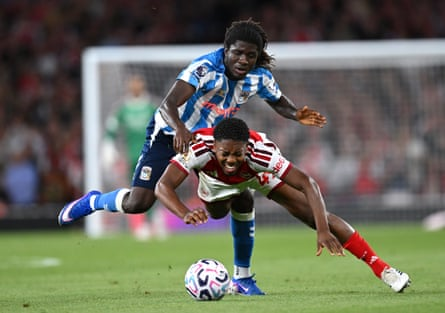
Caleb Yirenkyi challenges Arsenal’s Myles Lewis-Skelly on his Coventry debut, having joined for £23m this summer. Photograph: David Price/Arsenal FC/Getty Images
Remember the Peter Odemwingie deadline day fiasco, where Odemwingie sat fuming in his car while the world was sucked into this human drama? That whole thing was about the unbridgeable leap from £2m to £3m. Coventry have just signed Caleb Yirenkyi from Nordsjælland for £23m. Does “Caleb Yirenkyi” really exist? Are you sure?
Transfer window verdict: how every Premier League club faredRead more
Who pays in the end for this circulation of funds? You, for starters. There is no such thing as football money. It’s all TV rights, state propaganda funds and hard private investment from the kind of people who really don’t give without taking back in the end.
On one level books are being balanced, accounting rules satisfied, clubs swapping assets at fees driven in part by regulatory requirements. More obscurely Boehly once talked about a rush of cash being diverted football’s way as a sub-avalanche from quantitative easing in the US, because money just has to go somewhere. No, me neither.
All that seems certain is money is being pushed around the board. And that it feels wildly abstract. The window was thrilling, its possibilities endless, a shot of blood for the new season. Beyond this, big football and big finance are playing their own game, in a way that goes beyond the human scale and into a world of pure money. The message below the headlines is clear. This thing belongs to them. Your job, human consumer unit, is simply to look at it and have feelings.


