Haaland or no Haaland? The If, When, and Why for FPL Managers

Erling Haaland is priced at a record £15.5m for the 2026-27 FantasyPremier League season. Is he worth spending the money on for FPL managers?
In the 1990s, Dave Cirilli, a friend of American sports media personality Bill Simmons, noticed something strange about New York Knicks great Patrick Ewing. The Knicks seemed to perform better when their star man was absent.
Simmons later popularised the idea as the “Ewing Theory”, the notion that a team can sometimes become better overall when its biggest star is removed from the equation.
Could Fantasy Premier League have its own version?
Erling Haaland is priced at a record £15.5m for the 2026-27 season, and Fantasy managers are debating whether devoting so much of their budget to one player is worthwhile, or whether they could achieve better results in the opening gameweeks by spreading that money across the rest of their squad.
Haaland Is an Output Machine (But There’s a Catch)
Haaland’s FPL price tag may be one of the first records he’s set off the pitch, but it’s no doubt come as a result of all the records he’s broken on the pitch.
Among them:
- Fastest player to score 100 Premier League goals (111 matches)
- Fastest player to score 50 Champions League goals (49 matches)
- Most goals in a single Premier League season (36 in 2022-23)
- Most goals by a Premier League player in all comps in a single season (52 in 2022-23)
- Best mins/goal in Premier League history, minimum 20 goals (98.5)
- Best mins/goal in Champions League history, minimum 20 goals (80.9)
Those achievements certainly go some way to explaining his cost, and why, despite that cost, he is still selected by nearly three-quarters of Fantasy managers at the time of writing.
Electing to go without Haaland is a brave choice at any stage of the season, but as the data in the graphic below suggests, doing so at the start of a new campaign is when that decision presents the most risk.
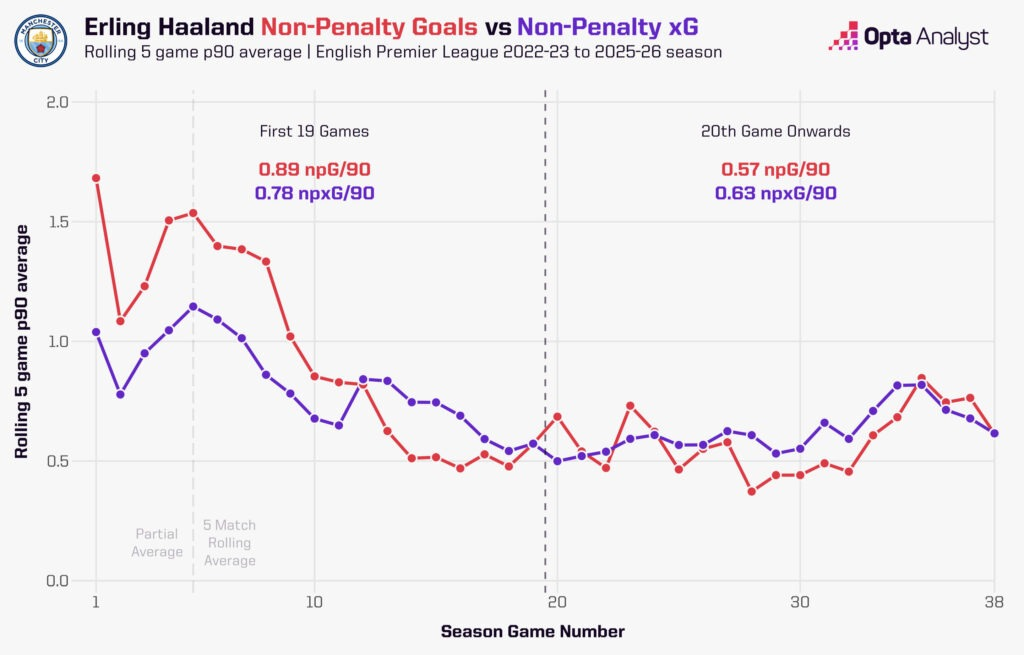
Haaland holds the record for the most goals scored across a team’s first five games of a season, with 10 in 2024-25. He also ranks joint-second with nine in 2022-23 and joint-fourth with seven in 2023-24. Even last season, his slowest start by this measure, he still scored six goals in Manchester City’s first five games.
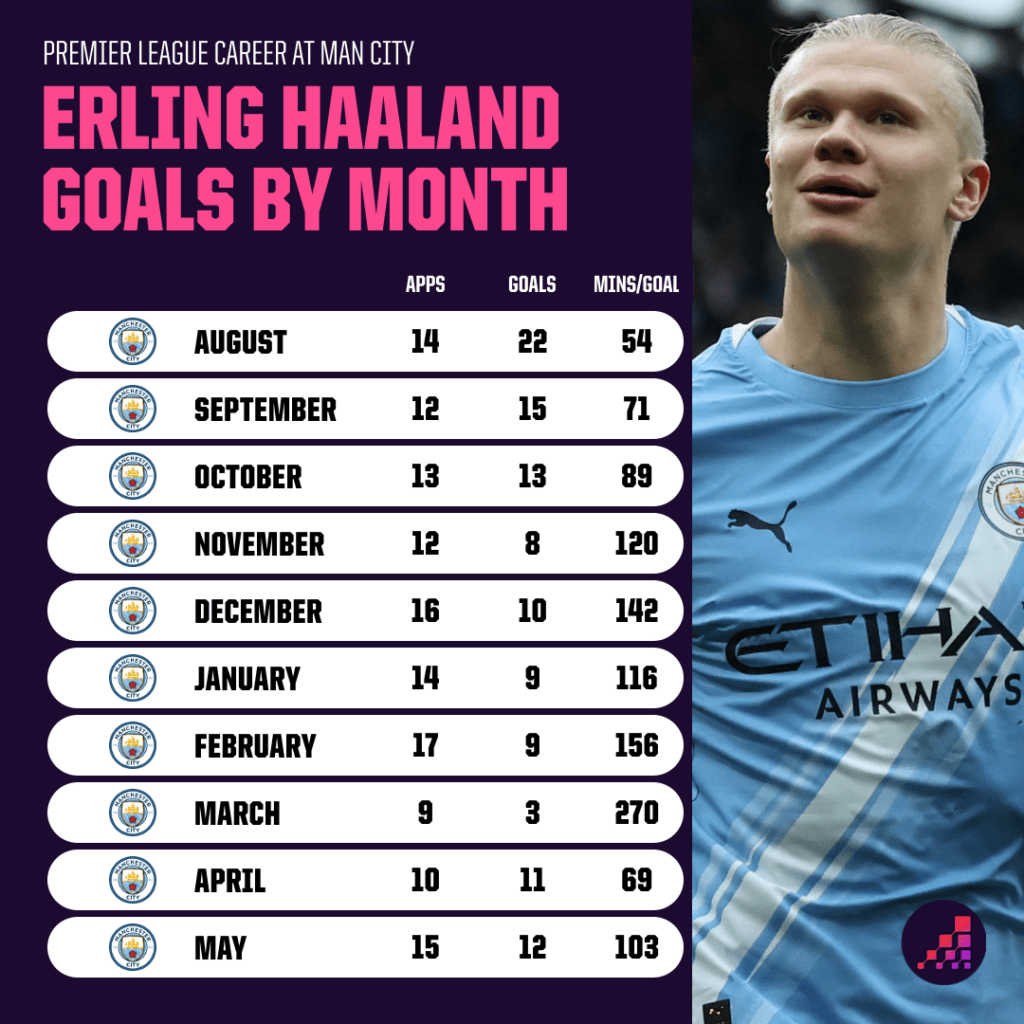
Breaking down the data from Haaland’s four Premier League campaigns into monthly windows highlights a habit of ‘slowing down’ after an initial flurry of goals.
His record in August alone is remarkable, with 22 goals from 14 matches. He’s had more hat-tricks (four) than games without scoring (three).
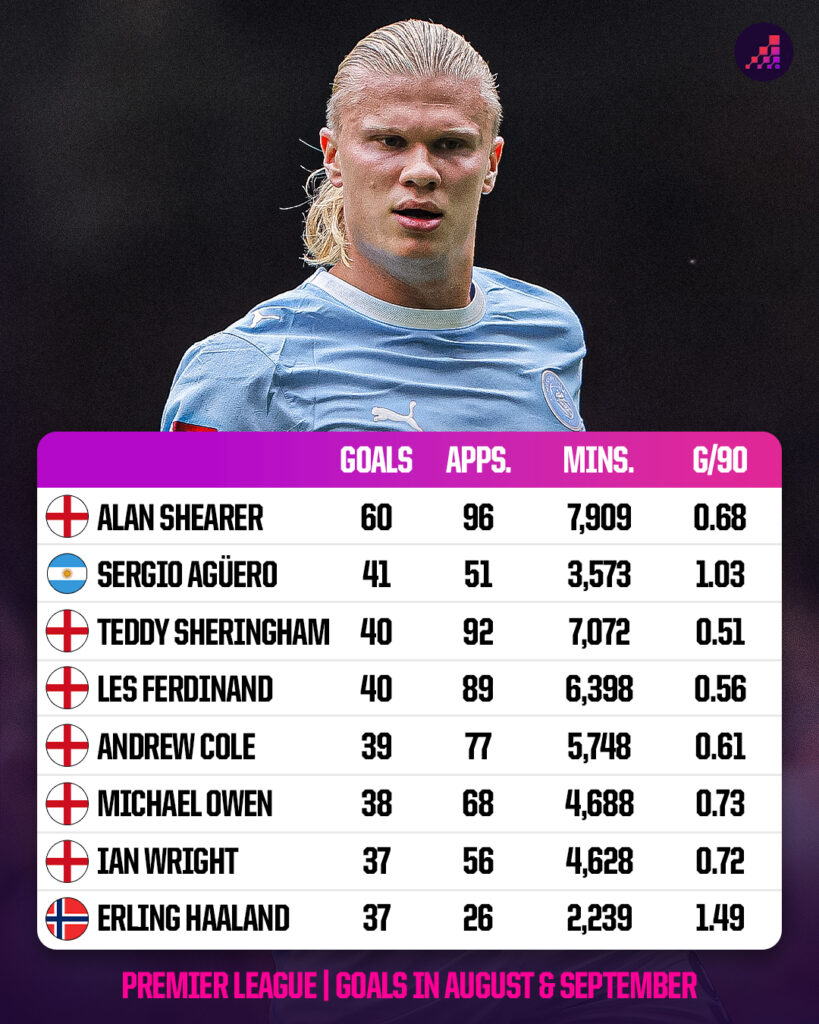
Indeed, August (22 goals), September (15) and October (13) rank first, second and third among Haaland’s most prolific months in the Premier League.
But after averaging 68 minutes per goal across the first three months of the season, he shows signs of being human during the middle portion of the season, scoring every 144 minutes between November and March.
He then typically returns to form for the run-in, with a goal every 87 minutes during April and May.
So, should those who are considering going without Haaland at some stage this season wait until he’s gotten his early-season heroics out of the way first?
Then again, he might not get much of a chance to break records in the early months of this season. There’s a possibility that Haaland may be eased back into action by Enzo Maresca following the World Cup, and that presents an opportunity for FPL managers to go against the crowd and use captaincy elsewhere early on.
More FPL Advice For GW1:

Premier League
FPL New Signings 2026-27: Which Summer Transfers Offer the Best Fantasy Value?
4 days ago Dan Edwards

Premier League
FPL Set-Piece Stats: Expected Takers, Players to Target, and Projections for 2026-27
2 weeks ago Dan Edwards
Haaland’s FPL Value in Context
Haaland is clearly deserving of being the game’s most expensive player this season, but how do we interpret his value? Last season, based on his end-of-season price, he earned 16.3 points per million in cost, which ranked just 18th among forwards.
But clearly this doesn’t tell the whole story. Every Fantasy manager starts with £100m to spend, but value and points are different objectives. Finding players who provide excellent value is important, but a player returning six points per million isn’t automatically preferable to one returning five per million if the latter player still produces substantially more points overall.
Manchester United’s Bruno Fernandes, for example, only ranked 27th among midfielders for points per million (22.6) based on his final price, while Arsenal’s Gabriel Magalhães ranked 14th among defenders (28.6). Yet after Haaland (239), Fernandes (235) and Gabriel (209) were the second and third-highest-scoring players in FPL last season.
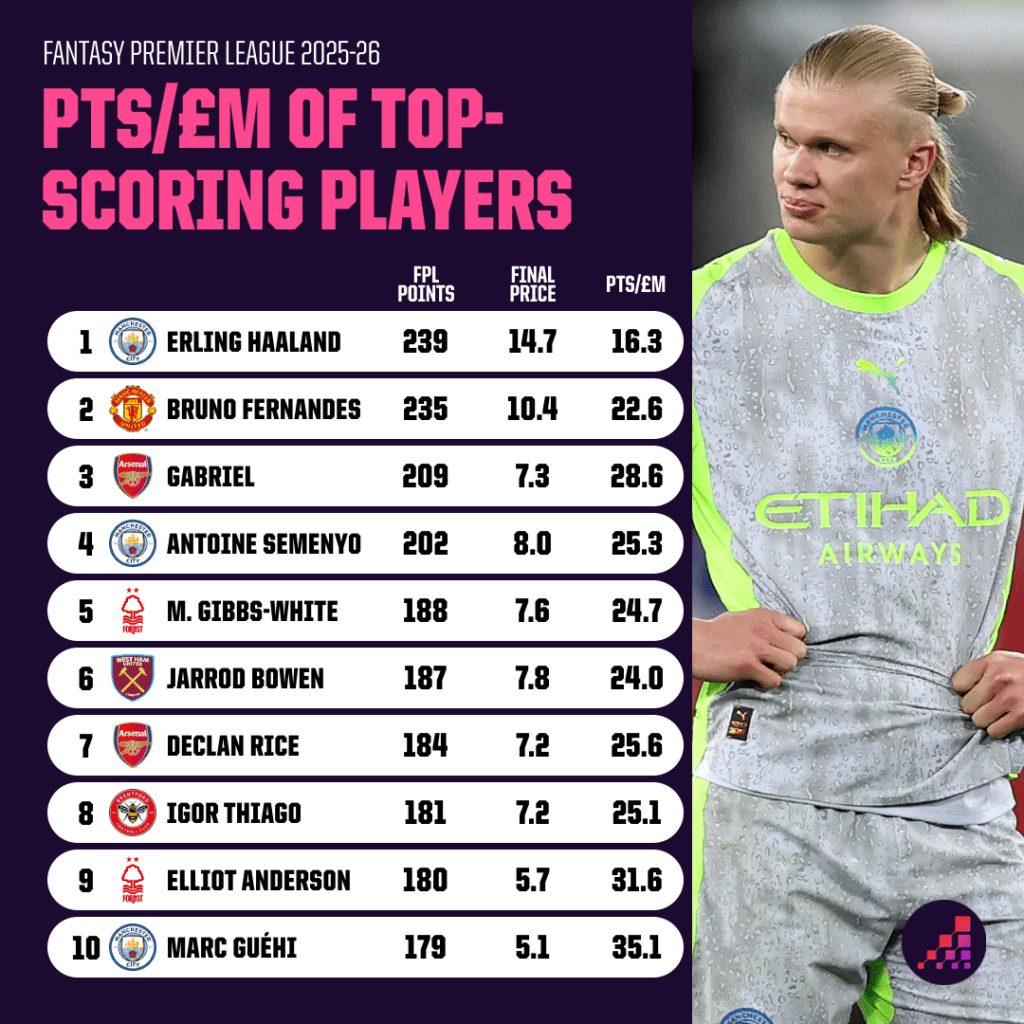
Ultimately, the aim is not to build the squad that returns the most points per million, but to use the full £100m budget to get as many points as possible. That inevitably means investing in some premium players whose value may appear relatively poor in isolation.
The question, then, may not be whether Haaland himself provides good value in isolation early on in 2026-27, but whether spending £15.5m on him produces a better team than spending that money elsewhere.
Haaland, No Haaland, FH3 and WC3
To put that theory to the test, we can use Solio Analytics’ squad planning tool to work out projected points totals for squads with and without Haaland over the first five gameweeks, which covers the period before the first international break.
Solio’s tool allows users to plan by optimising their squads for future gameweeks, recommending transfers and showing you the potential points uplift generated from each move.
We can also set hard rules for the optimiser, such as telling it that our squad must or must not include Haaland, and we can specify which gameweeks these rules apply to.
Let’s set up two scenarios: one team that must include Haaland for the first five gameweeks (scenario 1), and one team that must not (scenario 2).
In scenario 1, despite Haaland’s cost, the tool still manages to create a squad that also features Fernandes, the most expensive midfielder (£12.0m), and Gabriel, the most expensive defender (£8.0m).
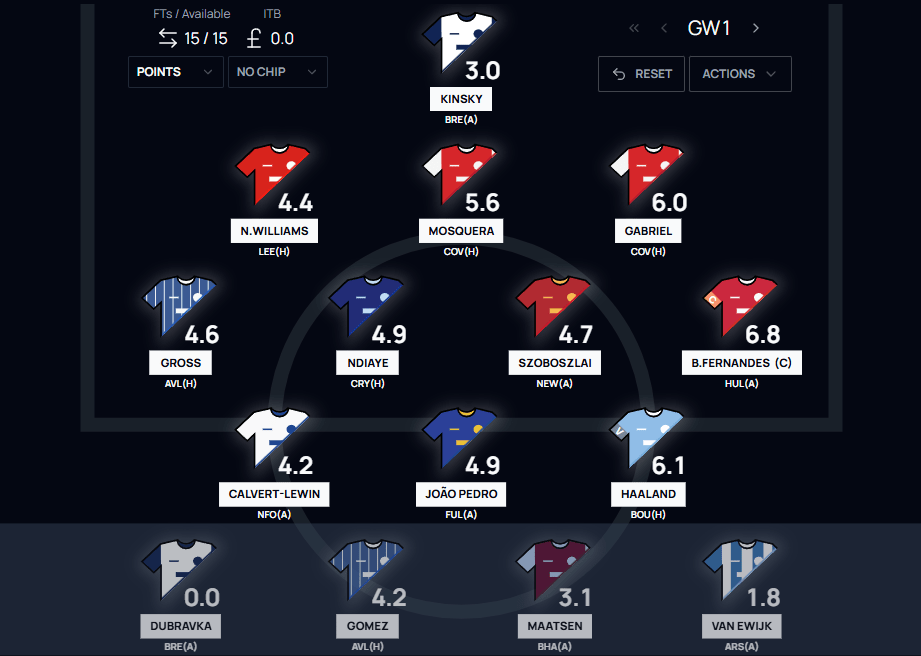
Solio’s recommendation is to make no transfers until GW4, when we can remove Fernandes to captain Chelsea’s Cole Palmer at home against Hull City. In GW5, the recommendation is to switch Arsenal defender Cristhian Mosquera out for Newcastle United’s Malick Thiaw, who faces Hull at home, and Brighton’s Diego Gomez for Nottingham Forest’s Morgan Gibbs-White, who faces Coventry City at home.
The projected total across the first five gameweeks for scenario 1 is 307.4 points.
Now let’s take a look at scenario 2, where the optimiser has been told that Haaland must not be owned at all.
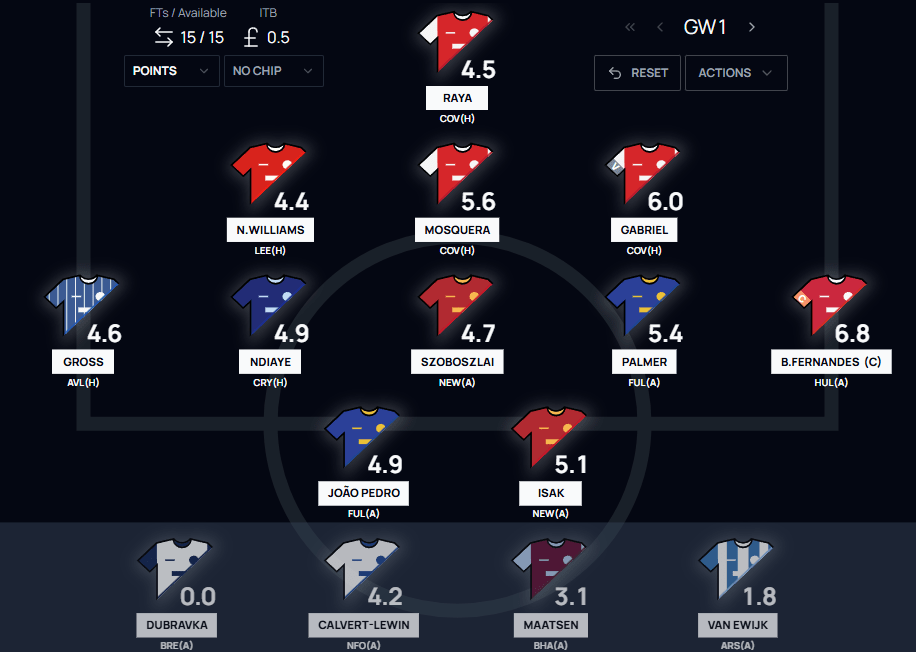
Haaland’s forced exclusion has led to only three changes. He has been replaced by Liverpool’s Alexander Isak (£9.0m), and the £6.5m saved from that switch has been used to upgrade Tottenham Hotspur goalkeeper Antonin Kinsky to Arsenal’s David Raya, and Gomez to Palmer.
Similarly to scenario 1, no transfers are recommended until GW4, when Mosquera is removed for Chelsea’s Marco Palestra for their home match against Hull. In GW5, Palestra is removed for Thiaw’s home match against Hull, and Liverpool’s Dominik Szoboszlai is removed for Gibbs-White’s home match against Coventry.
The projected total across the first five gameweeks for scenario 2 is 305.7 points. This is just 1.7 points fewer than scenario 1, a difference too small to suggest meaningful advantage to either approach.
Scenario 2 is projected to outscore scenario 1 by a small amount in both GW1 and GW2, and that’s because Fernandes, who faces Hull and Ipswich Town, is projected as the top points scorer in both weeks, and is therefore the recommended pick for captaincy.
Where scenario 2 falls short of scenario 1 is in GW3, when Haaland is the clear captaincy choice against Coventry. His projected return of 8.1 points is comfortably higher than the next best options, Fernandes and Haaland’s Man City teammate Antoine Semenyo (both 5.6). Here, scenario 1 earns a projected 60.3 points, compared to 55.3 for scenario 2.
This is where Fantasy managers electing to go without Haaland are taking the biggest risk, but using one of the four chips allows for the best of both worlds. One option to consider is to use the Free Hit chip in GW3. Let’s create scenario 3, where the optimiser has been told that Haaland is not allowed to be owned in GW1 or GW2, and that the Free Hit chip has to be played in GW3.
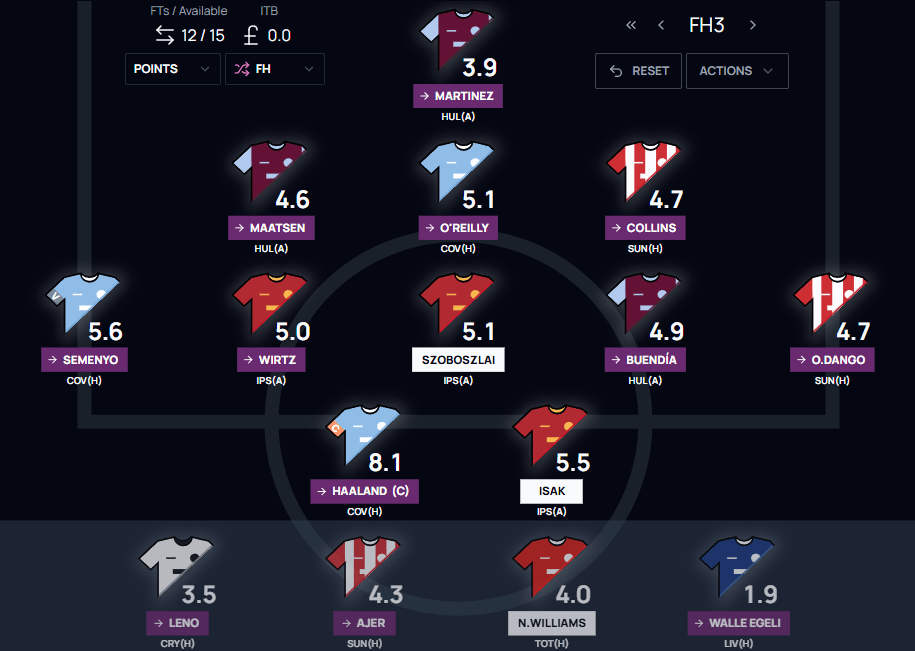
The Free Hit shows its value here, making 12 changes compared to the previous week, targeting players with fixtures against Hull, Ipswich, Sunderland, and, most importantly, Coventry, with Haaland brought back in to captain the team. This sees an uplift to 66.2 projected points for GW3.
The squad resets to its previous incarnation for GW4, and three transfers are made in a single week in GW5, when Gabriel is removed for Thiaw, Fernandes is removed for Gibbs-White, and Haaland is brought back permanently for Isak.
The projected total across the first five gameweeks for scenario 3 is 317.3 points, taking the lead because of the well-placed use of the Free Hit.
Let’s look at one more approach, scenario 4, where Haaland is once again excluded from GW1 and GW2, but the Wildcard chip is used in GW3 instead of the Free Hit.
Because the squad is being made anew in GW3, the optimiser has prioritised players with the best opening two fixtures, with no reason to be concerned about games beyond that point.
The key difference here is that, in addition to Fernandes, Bryan Mbeumo and Matheus Cunha are also brought in to create a triple-up on Man Utd’s midfielders for their matches against Hull and Ipswich. This leads to scenario 4 leading all other scenarios for projected points in both GW1 and GW2.
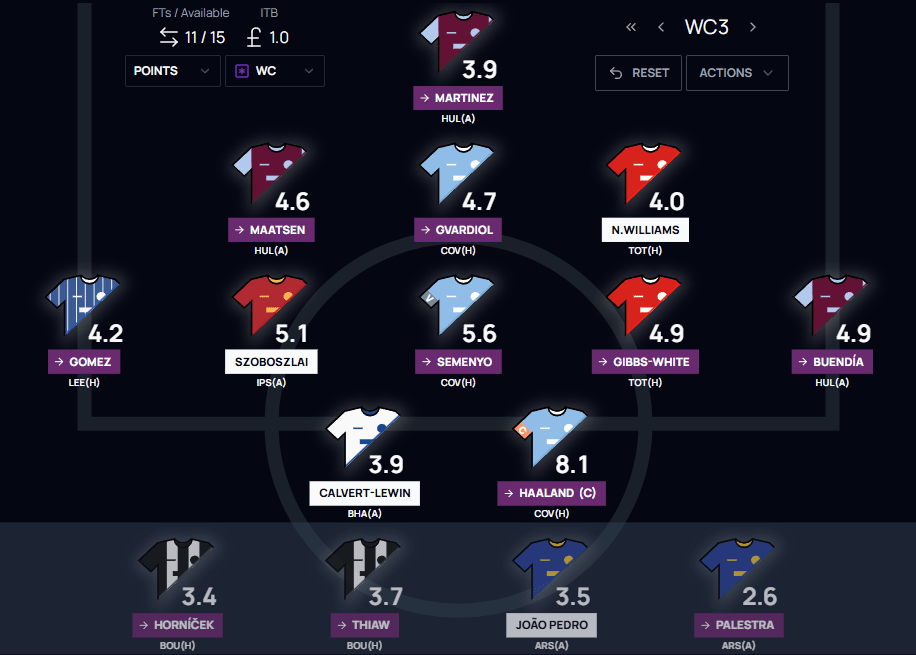
Similarly to scenario 3’s use of the Free Hit, scenario 4 recommends wholesale changes in GW3 when using the Wildcard. Unlike the Free Hit, however, these changes are permanent, so the optimiser must also account for future fixtures. That results in greater investment in Chelsea and Newcastle players ahead of their upcoming home matches against Hull.
Semenyo is removed in GW4 to bring in Palmer, and Aston Villa’s Emiliano Buendia is transferred out for Everton’s Iliman Ndiaye, who faces Ipswich in GW5.
Despite gaining the ability to target the opening two gameweeks in isolation, the projected total across the first five gameweeks for scenario 4 is 315 points , ever so slightly lower than scenario 3. As shown below, Solio’s planning tool allows us to see a projection for each scenario, showing where one approach betters another on a week-to-week basis.
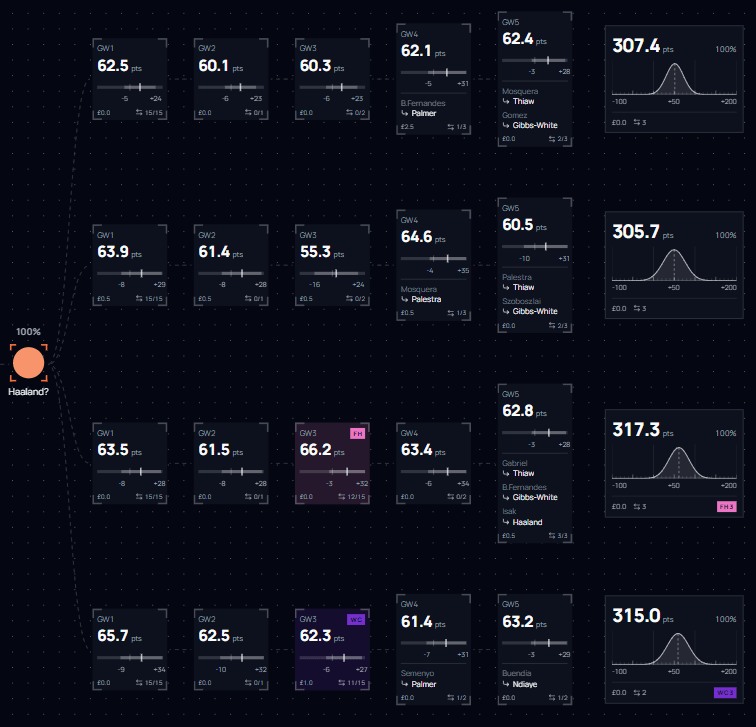
We get the following outcomes:
Scenario 1: Own Haaland for first 5 GWs (307.4 points)
Scenario 2: Do not own Haaland for first 5 GWs (305.7 points)
Scenario 3: Do not own Haaland, but Free Hit in GW3 (317.3 points)
Scenario 4: Do not own Haaland, but Wild Card in GW3 (315.0 points)
So, what do these five-week projections tell us?
The difference between scenarios 1 and 2, where no chip is used, is small enough to indicate that any advantage of taking either approach to the Haaland question is negligible. There’s even the aspect of bench boost to consider, with many FPL managers potentially tempted to use theirs in GW1 or GW2. It is possible for those avoiding Haaland to keep pace with those who do own him, but the current projections don’t envisage any real advantage to either approach. That suggests that he has been priced very well.
The FH3 and WC3 approaches, for Fantasy managers who have doubts about Haaland’s immediate impact this season despite his historical output, but who don’t want to miss out on his GW3 match against Coventry, produce similar projections to each other before the first international break. Both provide an uplift on scenarios 1 and 2, as expected given the use of a chip, with FH3 coming out slightly on top.
Whether you pick Haaland or whether you’re a firm believer in the Ewing Theory, there doesn’t appear to be a compelling projected advantage to starting with or without him. The greater advantage may instead come from planning to make use of both approaches at the most impactful moments.
Of course, this decision will also depend on your own beliefs, which you can edit with the Solio tool – about Haaland’s minutes, whether Man City can make a quick start under Maresca, and how other premium players like Bruno Fernandes and Gabriel start the season. Either way, the Haaland or no Haaland decision promises to be the most significant one for FPL managers before Friday’s GW1 deadline.
Rather than if you should pick Haaland, maybe the better questions are when and why.
Enjoy this? Add Opta Analyst as apreferred source by clicking here.
_Subscribe to ourfootball newsletter to receive exclusive weekly content. You should also follow our social accounts over on _X** ,Instagram, TikTok and Facebook.**