
Mikel Arteta Rails Against Premier League Managers’ Attacks—Receives Surprise Support

Home/Soccer
Mikel Arteta Rails Against Premier League Managersâ AttacksâReceives Surprise Support
Arsenalâs tactics have inspired calls of a changes to the laws of the game from rival Premier League managers.

By Grey Whitebloom
9:30 AM EST
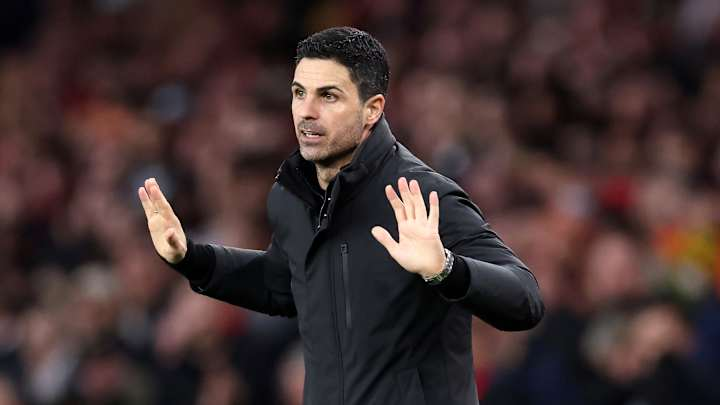
Mikel Artetaâs Arsenal have come under fire for their rough tactics. / Catherine Ivill-AMA/Getty Images
Arsenalâs set-piece tactics have inspired criticism from several Premier League managers but Mikel Artetaâs only issue is that his team havenât scored enough from dead-ball scenarios.
The Gunners equaled the Premier League record for corners scored in a single season with their 15th and 16th goals from this avenue during Sundayâs win over Chelsea. Arsenal have mastered this particular aspect of the game over recent years, although the physical approach they take in such situations has inspired outcries.
Liverpoolâs Arne Slot led the way, lamenting how âhis heart as a former playerâ doesnât like the rough treatment in penalty boxes. âHere, you can almost hit a goalkeeper in the face and the referee still says, âPlay on,ââ he claimed.
FREE NEWSLETTER. New SI FC Newsletter Global Embed. Sign Up to Get Informed With SI FC. dark
Brighton & Hove Albion boss Fabian Hürzeler previewed Wednesdayâs meeting with Arsenal by bemoaning the amount of time they take before each corner. Manchester Unitedâs Michael Carrick has also offered his opinion on the situation yet Arteta found an unlikely supporter in the form of his direct rival for the Premier League title, Pep Guardiola.
âItâs Gone Too Farâ
Brighton are drifting under Fabian Hürzeler. / Darren Staples/AFP/Getty Images
âFor me, the main topic is [to] make a clear rule how much time you can waste for a corner, for a throw-in, for a free-kick,â Hürzeler fumed in midweek. âWhen Arsenal has a corner and they are leading, sometimes they spend over one minute just to take a corner.â
The Brighton boss is backed up by the numbers. Arsenal take an average of four minutes and 18 seconds to prepare for corners each game, the most of any team in the division, per Opta. It would be quicker to drive from London to Brighton (one hour, 56 minutes) than watch a supercut of Arsenalâs preparations for corner kicks over the course of the entire season (two hours, five minutes).
âIt disturbs the rhythm of the game,â Hürzeler fairly argued before turning to another divisive aspect of the Gunnersâ routines. âSome of the blocking or the way teams are blocking, I think thereâs no clear ruleâsometimes the referee whistles and itâs a foul, sometimes he doesnât.â
Next. Greatest Soccer of All Time. The Greatest Soccer Players of All Time. dark
Arsenalâs charge from the back of the box towards the near post is a hurly-burly ballet of intricate coordination. While those who eventually meet the in-swinging delivery from Declan Rice or Bukayo Saka claim the headlines, the players that position their bodies in such a way to prevent their opponents from making contact are just as important.
Unitedâs Carrick argued that the level of contact allowed has âgone too far.â
âIt wasnât long ago we were told you couldn't lay a hand on anyone in the box and it would be stamped out,â he grumbled. âItâs crept in. The success of set pieces, corners in particular, probably in terms of being able to put so many bodies close together, has made more teams do it because the success rate is so high.
âItâs understandable why there are so many teams doing it. As a game, it doesnât feel like weâve got that balance right.â
Arteta Dismisses Criticism, Offers Explanation
Mikel Arteta isnât fazed by criticism. / Stuart MacFarlane/Arsenal FC/Getty Images
Arteta would not be drawn on Hürzelerâs criticism of Arsenalâs timings, dismissing it as âpart of the job.â
With a mischievous glint in his eye, Arteta added: âI am upset we havenât scored more and that we have conceded [from set pieces] as well. We want to be the best and most dominant team in every aspect of the game. That is the trajectory and the aim of this team.â
Artetaâs argument is that Arsenal are simply making the most of the cards they have been dealt. Play the game or get played. More interesting is his reasoning as to why it is increasingly difficult to create chances from open play: the rise of man-to-man marking.
âThere are phases, and there are moments when a team has an opportunity to do certain things, and the game is evolving, and the game is becoming more and more difficult [in open play],â he fretted.
The Premier Leagueâs Set-Piece Obsession
| League | Total Set Piece Goals | Proportion of Total Goals From Set Pieces |
|---|---|---|
| Premier League | 202 | 25.6% |
| Serie A | 155 | 23.6% |
| Bundesliga | 145 | 21.2% |
| La Liga | 128 | 18.6% |
| Ligue 1 | 99 | 16.4% |
Stats via WhoScored .
The concept of having players drift into different zones of the pitch to create numerical overloads is no longer effective if every member of the defending team is prepared to track each step made by their opponent.
âBefore, when you used to do a game plan, and you just invert a fullback and bring an extra player in midfield or a false nine, the opponent is âFini!â Big overload, four vs. three inside, two vs. one inside, time on the ball,â Arteta explained. âSo dominant, 70â80% of possession, the other opponent, two counter-attackers, set pieces, the game is done.
âNow, teams are adapting.â Including Arsenal.
In that aforementioned Chelsea game, Liam Rosenior tried to tease apart the stitching of Arsenalâs rearguard with some inventive open-play tactics. Cole Palmer and Enzo Fernández traded positions freely, bamboozling MartÃn Zubimendi as he tried to track both players for much of the first half. Arteta spotted this issue and tweaked the man-marking brief: Zubimendi would only deal with Fernández while one of Gabriel or William Saliba was to track Palmer. Chelsea scarcely had a sniff thereafter.
âTeams know after every sequence of play, whether itâs a throw-in, a restart of play, an open-play situation, or after direct play, exactly what they have to do, and everything is almost man-to-man,â Arteta pointed out, from experience.
Pep Guardiola Preaches the Ultimate Lesson: Adapt or Die
Pep Guardiolaâs confidence is building. / Robbie Jay Barratt/AMA/Getty Images
âI understand completely the reason why Arne said that and in some aspects I agree,â Guardiola conceded. But he would not be joining in the pile-on. âYou can sit and complain, but you have to adapt,â Manchester Cityâs revered tactician insisted. âYou have to adapt and especially adapt in the way it is whistled [refereed] and conducted in the Premier League.â
Guardiolaâs entire managerial career is an example of supreme adaptation: âFootball is about how, when the opponents create problems for you, you have to find a solution.â
After instilling a brand of positional play at Barcelona which took Europe by storm at the start of his managerial career, Guardiola has set about changing his approach to combat the challenges set up by his opponents.
To get the best out of Lionel Messi when faced with a meaty wall of low blocks, he returned to the false nine concept. At Bayern Munich, Guardiola reintroduced the concept of inverted fullbacks to guard against counterattacks. The reverse is true: each attacking weapon Guardiola introduces inspires another response.
âWhen we started with Kevin De Bruyne in the channels between central defenders and fullbacks to the byline, people started playing five at the back,â Cityâs boss reflected. âWe killed them there with David Silva and Kevin De Bruyne so they said: âWe need another defender.â Itâs all evolution. Set pieces are the same.â
Arsenal are killing their opponents from corners but the most popular solution for Premier League managers seems to be crying foul play and demanding a change in the laws of the game.
READ THE LATEST PREMIER LEAGUE NEWS, ANALYSIS AND INSIGHT FROM SI FC
feed


