Former USMNT Star Backs Emma Hayes to Replace Mauricio Pochettino in Historic Plan
Former USMNT midfielder Kyle Martino has urged U.S. Soccer to give Emma Hayes responsibility for both national teams as it searches for Mauricio Pochettino’s successor.
Pochettino is leaving to join Manchester United after the November international window, and U.S. Soccer has set its sights high in the search for a replacement. Former Manchester City manager Pep Guardiola has reportedly turned down the opportunity to succeed the Argentine.
Martino believes the federation should look within its own ranks. His proposal would see Hayes remain in charge of the USWNT while also taking over the men’s team—a move he argues would put equal opportunity at the heart of American soccer.
“Emma Hayes is one of the best coaches in the world,” Martino said. “She’s got an incredible résumé. She’s done it abroad and done it here. She’s got a great relationship with U.S. Soccer and she’s got a great relationship with the fans.”
“Manage both teams. Manage the men and women at the same time. No one’s ever done it, let’s do it. Let’s lead the world of sports.”
Martino linked the idea to the equal-pay arrangements for the national teams, arguing that equal opportunities should be the next step.
“We have equal pay for our [men’s and women’s] players. We were a country that led the charge there, with other nations, let’s lead the charge on equal opportunities,” he said. “Very rarely does it overlap. The Women’s World Cup overlaps with the Gold Cup [next summer] but I’ve got an answer there. Let [Steve] Cherundolo [men’s U-23 coach] take the Olympic team to the Gold Cup.”
He also pointed to the national training center as a practical reason to consider the arrangement: “Emma Hayes. Right now. It’s a commercial business at the end of the day. Let Emma do it. You’ve got a national training center—both teams there at the same time. Let Emma do both!”
Hayes has already challenged the men’s-game narrative
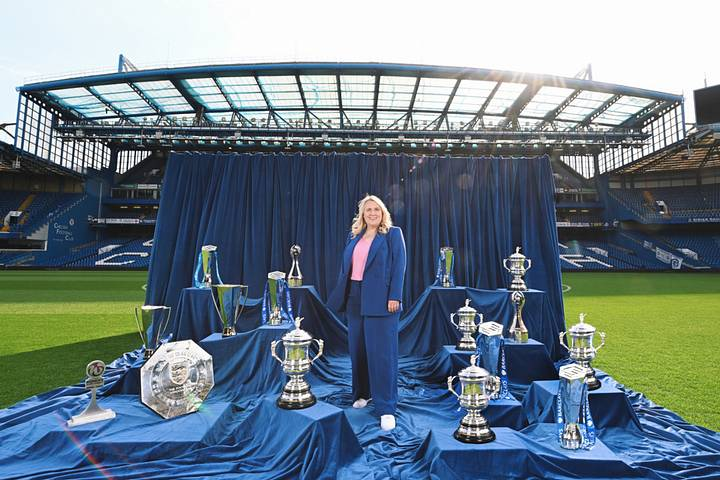
Hayes built her reputation through sustained success at Chelsea Women. She joined in the summer of 2012 and spent 12 years at the club, winning seven Women’s Super League titles and establishing Chelsea as a leading force in the women’s game.
Her insight as a television pundit during Euro 2020 also won over viewers unfamiliar with her coaching career, helping shift perceptions of women’s soccer in England.
Links with jobs in men’s soccer followed, but much of the speculation involved leaving an elite women’s side to begin again in England’s lower leagues. Hayes has pushed back against the assumption that such a move would represent a step up.
“As an Olympic gold medal-winning coach, the biggest priority for every media outlet in the British interviews I did afterwards was the men’s game,” she told The Times in November 2024. “It’s small-minded in so many ways.”
Asked about the idea that success in women’s soccer is treated as “bronze” against the “gold” of managing men, Hayes rejected the hierarchy.
“I don’t know how playing in front of 43,000 to win the Olympics at Parc des Princes can be a bronze. Know what I mean? Like, not to take anything away from Shrewsbury Town or Grimsby—which is the suggested level I should go into if I became a men’s coach.”
After the relentless questions in England, Hayes described working in the United States as a refreshing change, with recognition for what she had achieved in the women’s game.
“Working in the U.S. as a woman is a completely different world,” she said. “Equality.”
“We win the Olympics and in America they want to talk about the greatness of winning an Olympics. I come to England and have a week with the press and they want to ask me when I’m going into the men’s game! The morbid fascination with asking me that question … Going forward, I’m just going to refuse to answer it.”
A compelling résumé, a complicated proposition
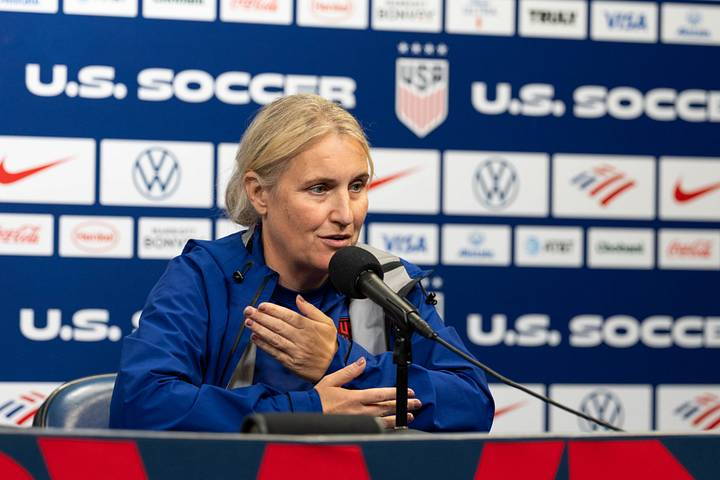
Seven WSL titles, numerous individual accolades and Olympic gold in 2024 give Hayes the kind of winning pedigree U.S. Soccer is seeking. Her success spans both club and international soccer, leaving little basis for the suggestion that she still needs a men’s job to prove herself.
If she were to consider coaching in the men’s game, the role would need to be at a sufficiently high level. In principle, the USMNT job could offer that stature. That remains an assessment of its potential appeal, however, rather than an indication that Hayes wants the position.
Her current focus makes an appointment highly unlikely. The USWNT are ranked second in the world and pursuing Spain at the top of the standings. The men’s team, ranked 16th and rebuilding, presents a different challenge.
Martino’s suggestion also carries substantial logistical difficulties. His proposed solution for the Women’s World Cup and Gold Cup overlap addresses one clash, but managing two senior national teams would still mean dividing attention between two demanding jobs. Hayes’s credentials explain the appeal of the idea; her commitment to the USWNT and the demands of a dual role make it an unlikely outcome.