Where did it go wrong for Sage at Palace?
Less than six months after lifting the French Cup with Lens, Pierre Sage has lost his job at Crystal Palace. A depleted squad and a mismatch between his football and the players available help explain the collapse.
Premier League · Analysis
As Pierre Sage waited to receive the Coupe de France trophy as Lens’ victorious manager last May, he turned to his staff and asked: “Do you realise where we are?”
He had just delivered the club’s first French Cup title while steering them towards second place in Ligue 1, their joint-best league finish in more than two decades. All of it came in his first season in charge, having managed only 56 professional games before taking the job.
The 47-year-old became a rising star of French football almost overnight, earning recognition as French manager of the year. The Premier League’s pull took him to Palace in July, but his reign lasted just 16 matches, including 10 league games. He leaves the Eagles bottom of the table with the division’s worst defence.
It is a striking fall for both a coach celebrated last summer and a club that lifted its first European silverware in the same month.
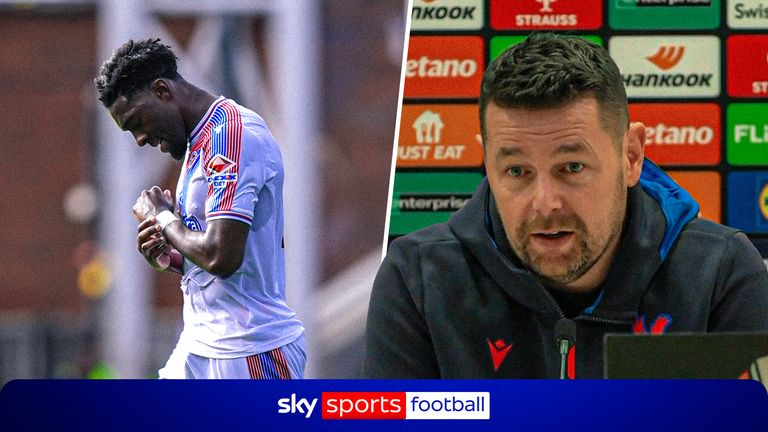
After the 2-0 defeat at Tottenham in his penultimate league match, Sage’s assessment was blunt: “It’s a disaster.”
The problems stretched well beyond that result. Daniel Munoz and Maxence Lacroix had departed in the summer. Ismaila Sarr was missing through injury after scoring 21 goals the previous season. Adam Wharton’s form had deteriorated, while Jean-Philippe Mateta was sent off 13 minutes into his second Premier League start since August.
Yet the difficulties also raise a more fundamental question: why did Palace believe Sage’s approach suited the squad they were putting together?
A rebuild that never repaired the damage
The defensive decline began before Sage arrived. Following Marc Guehi’s sale to Manchester City in mid-January, Oliver Glasner’s Palace conceded 26 goals in their final 16 games of last season — an even higher rate than under his successor.
A rebuild was already necessary before Munoz and Lacroix followed Guehi out of the club. Palace should have had the resources to address it, with money from the sales of Guehi and Eberechi Eze over the previous 12 months, alongside back-to-back seasons in Europe.
Instead, director of football Matt Hobbs’ first major test since succeeding Dougie Freedman has produced mixed results at best. Wing-back Anan Khalaili is creating a third fewer chances than Munoz, while loan signing Axel Disasi has struggled to reproduce Lacroix’s defensive dominance.
- Disasi’s aerial duels won
- 54%
- The centre-back was eventually dropped.
- Goals conceded from headers
- 7
- Three more than any other Premier League team.
Replacing Eze, Guehi, Munoz, Lacroix and Michael Olise across two years was never going to be straightforward. But while Brighton have continued to thrive despite losing leading players, few of Palace’s arrivals have come close to filling the gaps. Yeremy Pino is the notable exception.
The result was a squad that had lost much of its established quality without finding enough effective replacements.
The missing runners and Wharton’s decline
Of the players who remained, Sarr was Palace’s most productive attacking outlet. He scored 21 times in 45 appearances last season, but a recurring groin injury has left him barely involved under Sage.
His importance was already clear in 2025/26, when Palace’s league scoring rate fell by almost half to 0.71 goals per game in his absence. Mateta still finished that campaign as their leading league scorer with 12, but the pair contributed a combined 183 league minutes from a possible 1,260 during Sage’s reign.
Their absence has affected more than the finishing. Without Sarr’s runs and Munoz’s movement, Wharton has had fewer willing targets for his early forward passes.
The 22-year-old’s loss of rhythm appears to have extended to his work without the ball. Across the previous two seasons, he regained possession in the middle third more than three times per game on average. That figure now sits barely above one.
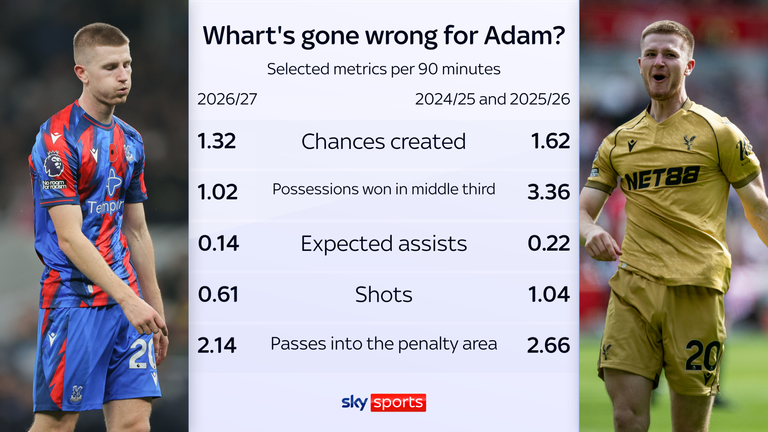
Wharton’s passing and ability to spot a runner would likely have suited Sage’s Lens side, which unsettled opponents through pressure, high turnovers and rapid transitions. Those qualities had also made him so effective in Glasner’s counter-attacking Palace team.
But the players and movement that made that approach work were no longer consistently available. Sage’s philosophy, meanwhile, remained intact.
“My idea is that the best way of defending is to have the ball, because then you cannot concede.”
That belief sat awkwardly with the team he inherited. Palace recorded possession of 42 per cent or less in 19 games during 2025/26. Under Sage, they had more than half the ball in only two matches, with just two sides recording less possession overall.
Keeping the ball as he wanted was never this squad’s strength. The goals-against column reflected the difficulty of trying to defend through a style they could not sustain.
Sage’s 3-4-2-1 at Lens relied on pressure in the opposition half and a high tempo, rather than the counter-attacking football Palace had become known for. The difference was stark in the chances created by winning the ball high up the pitch.
High turnovers ending in a shot
- Lens · last season
- Second-most
- Crystal Palace · this season
- Second-fewest
Sage’s work in France had been impressive enough to put him briefly on Liverpool’s radar during the summer. Palace’s desire to become more expansive was understandable, but they had not assembled a squad capable of meeting his demands.
His front-foot approach was closer to that of Andoni Iraola, whom Palace pursued before he joined Liverpool. Iraola’s Bournemouth had also been a very different team stylistically from the Eagles.
Perhaps Sage’s undoing was less about being the wrong manager for Palace than about Palace being the wrong club for him.