Man Utd Sack Michael Carrick
Premier League
Manchester United have parted company with Michael Carrick, ending a spell that began with renewed optimism and unravelled amid inconsistent results and growing tactical uncertainty.
“The club has come to the extremely difficult conclusion that a change is necessary in order to achieve our ambitions.”
The decision gives Carrick clarity after weeks of uncertainty following the 3–0 defeat to Bournemouth on Oct. 25. The former United midfielder’s enduring popularity with supporters reportedly helped prolong his tenure, but it could not protect him indefinitely.
Having handed him a two-year contract in the summer, United’s hierarchy allowed Carrick another three games to justify that commitment. A defeat, a victory and a draw followed, each exposing a different aspect of the instability he was struggling to contain.
United played well before collapsing against Chelsea, recovered from a desperately poor first half to beat a Roma side whose second-half performance was even worse, then packed those extremes into 98 chaotic minutes against Aston Villa on Sunday.
Across those contrasting contests, Carrick appeared increasingly unable to shape events. Lisandro Martínez losing his composure, favourable penalty decisions and Zion Suzuki’s vulnerability in the air all had a greater influence than the manager charged with restoring order.
U.S. men’s national team manager Mauricio Pochettino is expected to be the next man in the spotlight, with formal steps already underway to appoint the Argentine. His arrival remains prospective.
When simplicity stopped being enough
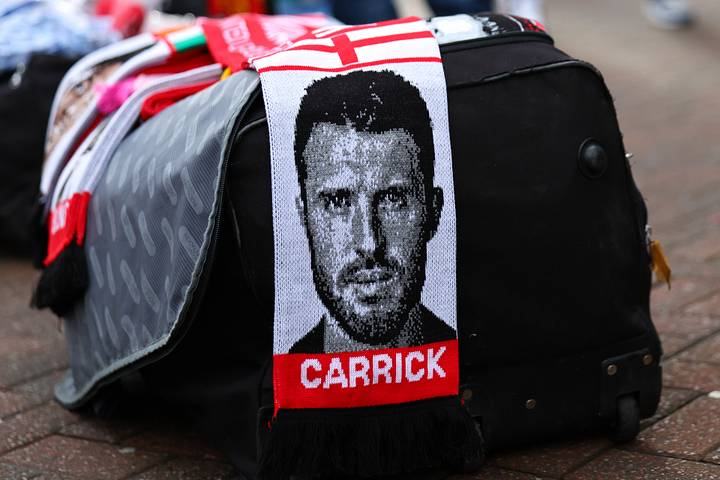
United had turned to Carrick in January to soothe the wounds left by Ruben Amorim, echoing the earlier appointment of Ole Gunnar Solskjær after José Mourinho’s departure. A familiar, reassuring figure offered an immediate change of atmosphere.
Carrick’s success over the second half of last season rested on straightforward decisions. He switched to a 4-2-3-1, used players in their preferred positions and relied on a settled core. An unusually sparse schedule gave that group ample preparation time between fixtures.
His calm manner also offered a welcome contrast to Amorim’s rigid tactical approach and volatile public comments. Asked about the term “philosophy,” Carrick’s response was blunt: “I hate that word.”
Once that initial freshness faded over the summer, however, the more proactive football he tried to introduce failed to take shape.
“Michael came in with the right ideas of giving the players responsibility, but also some freedom to take the responsibility on the pitch for the decisions that are needed.”
That balance proved difficult to maintain. When Carrick and his staff instructed the team to “half-press” against Como, Fernandes pointedly rejected the advice both on the pitch and in the media.
Like several predecessors, Carrick tried to develop United beyond a side dependent on counter-attacks. The coaching staff bore responsibility for the team’s ineffective pressing, yet by the end he looked more like a bystander than a manager directing a clear evolution.
Even the support he continued to receive during United’s slide into the relegation zone carried an uncomfortable implication: affection for Carrick had become detached from belief in his ability to change the club’s fortunes.
There were also limitations beyond any single selection. Starting Diogo Dalot at left back looked costly against Aston Villa, but the Portuguese defender had started at least half of United’s Premier League fixtures in five seasons under four different managers. Without a better alternative being recruited, Carrick could not simply conjure one into existence.
The early lift he provided had faded. The underlying problems remained.
Carrick in the post-Ferguson comparison
35
Games across two interim spells and his permanent tenure
48.5%
Win rate in the supplied managerial record
Carrick may leave with more goodwill than many of United’s managers since Sir Alex Ferguson, but his record sits near the bottom of the comparison. Of the seven managers listed, only Amorim had a lower win percentage.
| Manager | Games | Win % | Trophies |
|---|---|---|---|
| José Mourinho | 144 | 58.3% | Europa League, League Cup, Community Shield |
| Erik ten Hag | 128 | 56.3% | FA Cup, League Cup |
| Ole Gunnar Solskjær | 168 | 54.8% | — |
| Louis van Gaal | 103 | 52.4% | FA Cup |
| David Moyes | 51 | 51.0% | — |
| Michael Carrick | 35 | 48.5% | — |
| Ruben Amorim | 63 | 39.7% | — |
Statistics: Transfermarkt.
Amorim was the only other manager in that group to win fewer than half his matches, yet even he lasted longer than Carrick’s combined 35 games.
The comparison also casts David Moyes’s troubled season as Ferguson’s immediate successor in a different light. United finished seventh, a low point subsequently surpassed under Ten Hag and Amorim, but reached the League Cup semifinals and the Champions League quarterfinals. They even held Pep Guardiola’s Bayern Munich to a 1–1 draw in the first leg at Old Trafford.
“Moyes is a good coach,” Johan Cruyff said at the time, “just not for Man Utd.” With Carrick now gone and Pochettino expected to follow, the question of who can succeed in the job remains unresolved.